
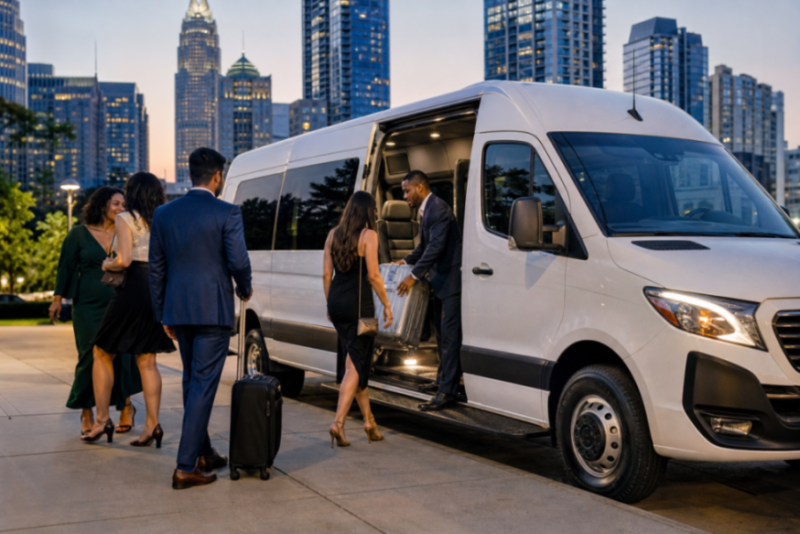
Shuttle planning for events in Charlotte, NC, requires systems that fit the local market—from downtown Charlotte and Ballantyne to Lake Norman and communities across the NC/SC border. Whether you’re coordinating guest arrivals for a wedding, moving attendees between venues, or arranging group transfers to and from CLT, a clear six-step approach reduces risk, improves guest satisfaction, and keeps your event on schedule.
Charlotte’s event geography matters: Uptown (central business district) has dense hotels and frequent short hops, Ballantyne and SouthPark are major corporate and hotel clusters, and Lake Norman or Huntersville pick-ups often involve longer drives on I-77 or I-485. Peak commuter windows and special-event traffic (stadium games, trade shows, convention center bookings) can change trip times dramatically—plan with local traffic patterns in mind and coordinate closely with venue operations for event-day access.
Why a Structured Approach Matters
Professional shuttle programs reduce delays, cut roadside confusion, and protect your reputation with guests and vendors. A reliable, chauffeur-driven shuttle—operated by an experienced provider like ILDA-VIP Services—gives planners control over capacity, equipment, timing, and safety while offering a consistent guest experience across the Charlotte metro area and neighboring communities such as Fort Mill, Rock Hill, Huntersville and Concord.
Step 1 — Define Needs: Guests, Origins, and Timing
Identify rider profiles and trip types
Start by listing who needs rides: VIPs, attendees with mobility needs, overnight guests, staff, or vendors. Note origin types: airport (CLT), hotels, remote parking lots, or private residences. Different rider profiles have different service requirements—luggage assistance for airport guests, ADA-compliant vehicles for accessibility needs, and staggered schedules for ceremony party members.
Estimate volumes and peak windows
Collect RSVPs or ticket counts and determine peak boarding windows—arrival and departure clusters drive vehicle counts. A practical way to size your fleet: identify your single largest 30–60 minute boarding window, total the riders expected in that window, then divide by the usable seating capacity per vehicle (see Step 2 for typical capacities). Add a 10–20% buffer for last-minute additions or no-shows when possible, and ask your transportation partner about minimums and cancellation policies.
Step 2 — Choose the Right Vehicles and Capacity
Vehicle selection affects routing, guest comfort, and curb access. For example, luxury sedans and SUVs suit VIP airport pickups and executive transfers; Mercedes-Benz Sprinter vans and shuttle-style vehicles work well for hotel-to-venue runs; and party buses or multiple Sprinters can move larger groups efficiently.
ILDA-VIP Services’ fleet options and vehicle-selection guidance can help match capacity to need—see the company’s vehicle selection guide for limousine, SUV and sedan options: Find the Perfect Ride With Our Vehicle Selection Guide for Limousine, SUV and Sedan Options. For shuttle-style and group planning, review their group transportation logistics page: Group Transportation Logistics for Events and Shuttles in the Charlotte Area.
Match vehicle features to trip length and guest expectations
- Short, frequent hops: Use vans or minibuses for quick turnovers and curbside access.
- Longer transfers (hotel-to-airport or out-of-town runs): Luxury sedans, SUVs, or Sprinters with luggage capacity and onboard climate control improve comfort.
- Special events (weddings, proms): Consider stretch limousines or Sprinters for bridal parties and guests; for high-energy group transfers, a party bus may be appropriate—review features and safety considerations in the party bus features guide: Party Bus Features in Charlotte.
Typical seating guidance (industry ranges): sedans 2–3 passengers, SUVs 4–6, Sprinter-style vans 8–14, and minibuses/coach shuttles 15–30. Use the usable seating number (account for luggage and accessible seating) when doing math—for example, if you expect 120 guests during a 45-minute peak and choose Sprinters with usable seating of 12, plan for 10 units plus backups and staging rotation.
Step 3 — Build Routes, Schedules, and Staging Plans
Design efficient routing
Cluster pickups by geography to reduce deadhead miles and shorten guest wait times. Map pickups using hotel clusters, neighborhood blocks, or centralized remote parking lots. For airport runs, align vehicle departures with flight arrival windows and allow time for baggage claim and curbside procedures—consult CLT guidance when planning airport meet-and-greets: Charlotte Douglas International Airport.
Use GPS routing with live traffic data (Waze, Google Maps, or integrated fleet telematics) to anticipate delays on I-77, I-85, I-485 and other busy corridors. For multi-venue events, create looped routes that return vehicles to staging rather than making long one-way transfers; this improves turn times and reduces empty miles.
Create clear staging and loading areas
Work with venues and hotels to reserve staging areas where drivers can wait without blocking traffic. Identify primary and secondary staging spots and mark them clearly on maps you distribute to drivers and guest-facing staff. If a venue restricts curb access, designate a nearby shuttle stop and communicate it to guests well in advance.
Example: for an Uptown wedding with several hotels within two blocks, pick a single hotel cluster as the primary pickup and use signed walkways or marshals to funnel guests to the correct vehicle—this reduces confusion and improves on-time boarding.
Step 4 — Coordinate With Venues, Vendors, and Local Rules
Get approvals early
Many Charlotte-area venues have specific rules for vehicle staging, drop-off/pickup points, and insurance requirements. Confirm load-in/load-out windows and whether the venue requires certificates of insurance or special permits. For municipal or stadium events—such as transfers to Bank of America Stadium—coordinate with venue operations teams on permitted vehicle types and approved staging zones.
Communicate clearly with vendors
Share your shuttle timeline with caterers, photographers, and other vendors who depend on precise timing. Include contingency plans for late arrivals so vendors can adapt without disrupting service. Where practical, include contact cards for driver leads so vendors can quickly confirm time-of-arrival or request hold times when delays occur.
Step 5 — Safety, Accessibility, and Compliance
Require vetted chauffeurs and vehicle inspections
Verify that drivers are licensed, background-checked, and trained in passenger assistance, defensive driving, and any needed ADA support. Confirm that vehicles meet inspection schedules and have working safety equipment such as seat belts and emergency supplies.
Plan for accessibility and special needs
Offer wheelchair-accessible vans or ramps as needed and collect accessibility requests before the event. Make sure pickup points have level access and that drivers are briefed on assisting passengers with mobility aids. A practical rule: for mixed-capacity events, keep at least one accessible vehicle staged for every 6–12 units depending on your passenger demographics; your transportation partner can propose the right ratio based on requests.
Document policies and insurance
Maintain written policies for wait-time allowances, no-shows, and vehicle breakdowns. Keep certificates of insurance on file and available to venues upon request.
Step 6 — Day‑Of Operations, Communication, and Contingencies
Staffing and dispatch
Assign a dedicated operations lead or dispatcher to monitor progress, manage vehicle reassignments, and communicate with drivers. Use real-time tracking where possible to provide accurate ETAs to guests and staff. For larger events, set up a simple command post (even a single tablet with live tracking and a phone line) so issues are resolved quickly.
Guest communication
Provide riders with clear instructions well before departure: pickup address and landmark, scheduled pickup window, driver/vehicle description, and contact numbers. Use text messages or a mobile event app for last-minute notices. For airport pickups, confirm flight numbers and enable flight-monitoring so chauffeurs adjust for early or delayed arrivals—see CLT airport meet-and-greet considerations: CLT Airport Car Service.
Sample short SMS: “Event Shuttle — Pickup: The Westin Uptown, valet area. Window: 4:15–4:35 PM. Look for vehicle: White Sprinter, Plate ABC123. Driver: Marcus, 704-555-0123.” Keep messages concise and include a direct contact.
Contingency plans
- Spare vehicles: Reserve at least one backup vehicle for every 8–12 scheduled units, depending on scale.
- Traffic delays: Build schedule buffers and consider staging earlier than strictly necessary for high-risk corridors.
- Inclement weather: Communicate alternate pickup locations if sidewalks or curbs are unsafe.
Practical Checklists for Planners
Pre-event checklist (4–12 weeks out)
- Confirm guest counts and special needs.
- Choose vehicles and reserve the fleet.
- Map routes, staging zones, and contingency stops.
- Obtain venue approvals and insurance certificates.
Week-of checklist
- Finalize pickup windows and driver assignments.
- Share maps and contact lists with drivers and venue staff.
- Send guest instructions with clear meeting points.
- Order signage and check-in materials for staging areas.
Day-of checklist
- Confirm all drivers have radios or mobile dispatch access.
- Verify vehicles are staged and stocked with necessary supplies.
- Monitor progress and adjust assignments in real time.
When to Hire a Professional Chauffeured Service
If your event needs consistent reliability, vetted drivers, or specialized vehicles (luxury sedans, Sprinter vans, or multi-vehicle wedding fleets), a professional chauffeur provider reduces planning overhead and operational risk. ILDA-VIP Services offers tailored group shuttle solutions across the Charlotte metro and nearby communities, including airport meet-and-greet, private chauffeurs, Sprinter vans, and party bus options. For vehicle type guidance, see: How to Choose the Right Vehicle by Comparing Sedan, SUV, Limo, Sprinter and Party Bus Capacity Features.
Measuring Success and Post-Event Review
After the event, collect feedback from guests, drivers, and venue staff. Measure on-time performance, average wait time, and incident reports. Useful KPIs include on-time percentage (target 90%+ for simple shuttles), average passenger wait, customer satisfaction score (post-event survey on a 1–5 scale), and any safety or service incidents. Use those data points to improve future shuttle planning, adjust vehicle allocations, and fine-tune communication strategies.
Final Recommendations
Shuttle planning for events is a logistics exercise that rewards preparation. Start early, choose the right vehicles, coordinate with venues and local authorities, and work with a transportation partner who understands Charlotte’s neighborhoods and CLT airport procedures. That approach minimizes friction and lets you focus on the core event experience.
If you need support executing an event shuttle program in the Charlotte area—weddings, corporate events, airport transfers, or group celebrations—call 704-807-8300 or make reservations online to discuss options and vehicle availability. Book a car or request a tailored group shuttle plan with ILDA-VIP Services for dependable chauffeur-driven transportation.
Frequently Asked Questions
How far in advance should I book shuttle service for an event in Charlotte?
Book as early as possible—ideally 4–12 weeks before the event. Larger groups, weddings, and weekend dates may require longer lead times to secure specific vehicle types and multiple units.
Can chauffeurs meet guests inside CLT baggage claim?
Yes—many chauffeured services offer meet-and-greet options at Charlotte Douglas International Airport and track flights to adjust for delays. Confirm the provider’s CLT procedures and any planned meet-and-greet instructions in advance.
What vehicles are best for hotel-to-venue shuttles versus airport transfers?
Hotel-to-venue shuttles often use Sprinter vans or minibuses for quick boarding and higher capacity, while airport transfers may use luxury sedans, SUVs, or Sprinters with extra luggage space depending on guest needs.
How do I handle accessibility needs during shuttle planning?
Collect accessibility requests in advance and arrange wheelchair-accessible vans or ramps. Coordinate with venues to ensure accessible pickup points and brief drivers on assistance protocols.
What contingency plans should I include for day-of operations?
Include spare vehicles, schedule buffers for traffic, alternate pickup points for inclement weather, and a dedicated dispatcher to reassign resources in real time.
Are there venue or insurance requirements for shuttle operations?
Many Charlotte venues require proof of insurance and may have specific staging or access rules. Confirm these requirements early and provide certificates of insurance when requested.