
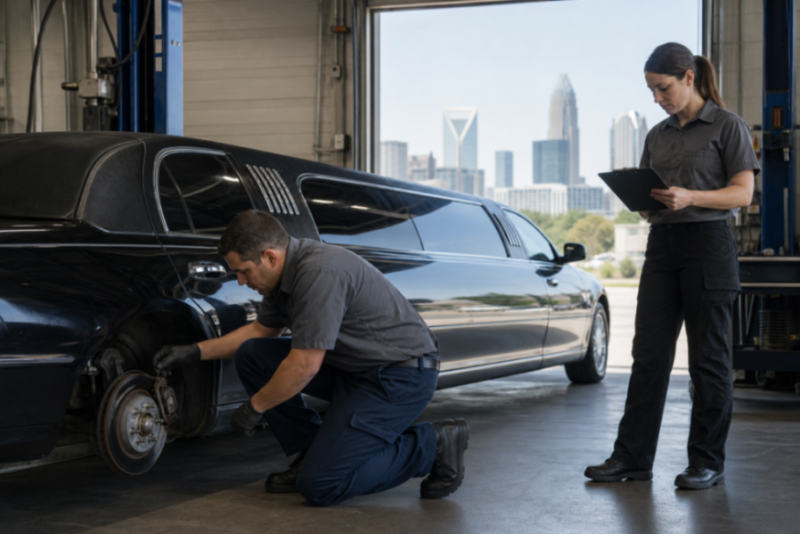
Hiring a professional limo company means entrusting a vehicle and driver with the safety and comfort of your group. Whether you are a corporate travel planner, a wedding coordinator, or booking a group transfer to CLT, knowing the right safety and maintenance questions for limo companies will help you choose a reliable provider and reduce day-of risk.
Why safety and maintenance questions matter
Chauffeured transportation blends a consumer service with public-safety obligations: vehicles must be well maintained, drivers must be properly trained and screened, and operational policies should reduce the chance of incidents. Asking pointed questions before you book clarifies vendor standards, identifies potential red flags, and sets expectations for service delivery.
Pre-booking checklist: Essential questions to ask
Use this short checklist as part of your vendor evaluation. These questions are practical, documentable, and should receive direct answers.
- Are your chauffeurs background-checked and licensed? Ask what checks are performed (criminal background, driving record) and whether drivers hold any local or state commercial licenses required for chauffeured service.
- What are your vehicle inspection and maintenance procedures? Request a summary of routine maintenance intervals, pre-trip inspections, and how issues identified during inspections are handled.
- Do you maintain maintenance and inspection records I can review? Reputable companies keep service logs; for high-stakes events you can ask for confirmation that the assigned vehicle has recent documented inspections.
- What are your policies for driver hours, fatigue management and substitutions? Long events and roadshows require clarity around maximum shift lengths, breaks and backup driver plans.
- What insurance coverages do you carry? Ask for certificate types and limits — commercial liability and passenger-coverage amounts — and confirm you will receive a certificate for your event if required by a venue or company policy.
- What happens if a vehicle becomes unavailable or breaks down? Understand contingency plans, timelines for replacement vehicles and any fees or responsibilities for the client.
Vehicle condition and maintenance: What to look for
There’s no substitute for a documented maintenance program. When you ask about vehicle condition and maintenance, expect answers that describe scheduled tasks and standards, not vague assurances.
Routine maintenance program
Good providers follow a scheduled maintenance program based on manufacturer recommendations and mileage. Ask whether they perform routine oil changes, brakes and tire inspections, and scheduled mechanical servicing, and how they document completed work.
Pre-trip inspection
Chauffeurs should complete a standardized pre-trip inspection checklist before every assignment. This typically includes tires, lights, wipers, fluid levels, seat belts, and basic HVAC operation. Ask providers to describe their checklist and whether reports are filed.
Tire, brake and suspension care
Tires, brakes and suspension components are safety-critical. Ask how frequently tires are checked for tread and pressure, when brakes are inspected or replaced, and how shock/strut wear is monitored, particularly for high-mileage stretch limousines and party buses.
Driver screening, training and conduct
Driver qualifications often matter more than the vehicle itself. The safest operators combine rigorous hiring standards with ongoing training and clear conduct policies.
Screening and records
Confirm that drivers undergo criminal background checks, driving-record reviews and any state-required medical or commercial testing. Ask whether the company audits driver files periodically and how long records are retained.
Training and ongoing monitoring
Ongoing safety training and in-service refreshers (defensive driving, passenger handling, emergency procedures) demonstrate a proactive safety culture. Ask whether the company conducts refresher training and if they use telematics or ride-monitoring tools to track speeding or harsh braking.
Substance policies and testing
Request the carrier’s substance-use policy and whether they conduct pre-employment, random or post-incident testing. Clear policies and testing reduce the chance of impaired operation.
Operational policies and emergency procedures
Beyond vehicles and drivers, operational policies determine how the company responds to common day-of issues.
- Breakdown and substitution policy: How quickly will a replacement vehicle arrive? Is there a documented contingency plan for major events?
- Inclement weather protocols: Does the company have minimum-safety thresholds for travel or alternative planning strategies?
- Accident response: Ask how the operator will handle a collision, including passenger care, vehicle recovery, and communication with your team.
- Passenger safety equipment: Confirm presence and condition of seat belts, fire extinguishers, first-aid kits and, for party buses, emergency egress instructions and lighting. For details on party bus safety features, see the provider’s party bus inventory and equipment descriptions: Party Bus Features in Charlotte.
Questions specific to weddings, corporate travel and airport transfers
Different events create different risk profiles. Tailor your safety and maintenance questions to the assignment.
Weddings and event transportation
For multi-vehicle wedding fleets or shuttle services, confirm vehicle matching, backup vehicle availability, and on-time guarantees. If your day requires multiple stops or photo timing, verify that the chauffeur understands ceremony timing and venue access rules. ILDA-VIP’s wedding resources and checklists can help planners confirm logistics and safety: Wedding Transportation in Charlotte, NC: Pricing, Capacity and Day-of Checklists.
Corporate and executive travel
Corporate travel often requires discrete, reliable service and corporate billing. Ask about corporate account safety protocols, preferred vehicle maintenance standards for executive sedans and SUVs, and whether the company provides driver continuity for roadshows and multi-stop itineraries. See recommendations for executive black car and corporate account benefits: Luxury Car Service in Charlotte, NC.
Airport pickup and flight monitoring
For CLT transfers, confirm flight-monitoring capabilities, on-time policies, and curbside/meet-and-greet procedures. Pre-booked chauffeurs should be prepared for delays and have a communication plan to coordinate with arriving passengers. For CLT-specific guidance see: CLT Airport Car Service.
Group vehicles and party-bus considerations
Party buses and large shuttles deserve additional scrutiny because of capacity and passenger behavior risks.
- Ask about maximum safe capacity and how it is enforced.
- Confirm party-bus safety equipment, emergency lighting, and clearly posted egress routes. Review the company’s party-bus safety policies and equipment lists: Party Bus Features in Charlotte and Party Bus Rental in Charlotte, NC: Capacities, Routes and Safety Policies for Group Events.
- Understand behavior rules and liability—no provider can fully control guest behavior, so confirm policies on alcohol, smoking, standing while the vehicle is in motion, and disciplinary/removal procedures.
Red flags that deserve follow-up
Watch for evasive or vague answers. Examples of red flags include:
- Reluctance to provide maintenance documentation or a general refusal to describe inspection routines.
- Unclear driver-screening policies or lack of written standards for background checks.
- No contingency plans for vehicle breakdowns or driver unavailability.
- Failure to disclose insurance limits or unwillingness to provide a certificate when requested.
How to document safety expectations in contracts
Include specific safety and maintenance items in your contract or statement of work: vehicle age limits, proof-of-inspection windows (for example: completed within 30 days of service), driver qualification clauses, contingency timeframes for replacements, and insurance certificate requirements. Clear terms reduce disputes and encourage providers to keep documented standards.
Final steps before you book
Before you confirm a reservation, ask for the following in writing or via email:
- Vehicle assignment and backup vehicle plan.
- Copy of driver qualifications for the assigned chauffeur (as permitted by privacy policies).
- Confirmation of on-site emergency equipment and seat-belt status.
- Contact numbers for a dispatch or operations manager available during your event.
Why ILDA-VIP Services focuses on safety and maintenance
ILDA-VIP Services operates throughout the Charlotte metro area and neighboring NC and SC communities, providing black car, SUV, stretch limousine, Sprinter, and party-bus options for weddings, corporate travel, airport transfers and group shuttles. Our standard operating practices prioritize documented vehicle maintenance, chauffeur vetting, and contingency planning so clients can focus on their event or itinerary. For help picking the right vehicle for your group, see our vehicle selection guide: Find the Perfect Ride With Our Vehicle Selection Guide.
Book with confidence
Asking the right safety and maintenance questions for limo companies takes a few extra minutes up front and can prevent costly problems on the day of service. If you’re planning a corporate transfer, wedding, airport pickup at CLT, or a group event in the Charlotte area, call ILDA-VIP Services at 704-807-8300 or make reservations online. Our operations team will answer your safety questions, provide documentation as needed, and confirm vehicle and driver assignments.
Frequently Asked Questions
What maintenance documentation should a reputable limo company provide?
A reputable provider should be able to summarize their scheduled maintenance program and provide records showing recent inspections and service (oil changes, brake and tire checks, and any manufacturer-recommended maintenance). For high-profile events you can request proof that the assigned vehicle had a pre-trip inspection within a stated window (for example, within 30 days of service).
How often should chauffeurs be screened and trained?
Drivers should undergo pre-employment background checks and driving-record reviews. Ongoing practices include periodic driving-record audits and recurring safety training (defensive driving, passenger handling and emergency procedures). Providers may also implement random substance testing and use telematics to monitor driving behavior.
What safety features should I expect on a party bus or large shuttle?
Expect clear seating capacity limits, working emergency lighting, accessible egress routes, functioning seat belts where provided, fire extinguishers and a first-aid kit. Also confirm policies for passenger behavior, onboard staffing, and how the operator enforces capacity and safety rules.
Is it reasonable to ask for a certificate of insurance before booking?
Yes. Many venues and corporate clients require a certificate of insurance that demonstrates adequate commercial liability and passenger coverage. Reputable companies should provide this upon request or as part of contractual documentation.
What should I do if the assigned vehicle breaks down on the day of my event?
Confirm the operator’s contingency plan before your event. A good company will prioritize replacement vehicle dispatch, provide a timeline for arrival, coordinate with your event staff, and cover reasonable costs for getting passengers to their destination when a breakdown occurs.
How do I verify a limo company’s safety claims?
Ask for written summaries of maintenance and driver policies, request sample inspection logs, verify insurance certificates, and inquire about training curricula. You can also check industry associations and local business licensing, and ask for references from recent clients with similar event types.